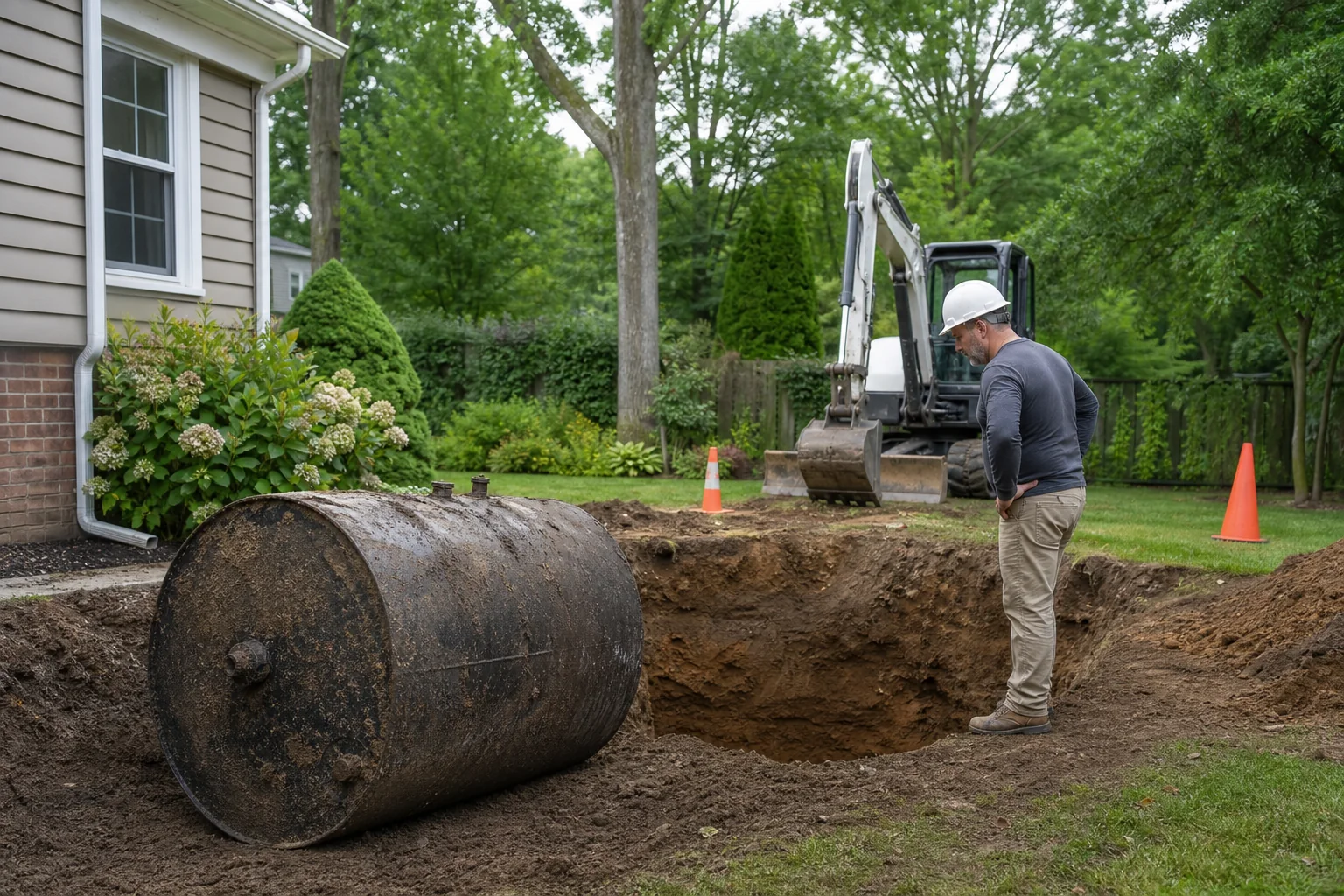
Why homeowners remove old tanks
A sale, a heating conversion, a failed inspection or a concern about leakage can all trigger removal. Removing an older tank can simplify the property record, but the responsible decision is based on the exact tank type and site conditions.
The steps that affect cost and timing
A reputable contractor should explain the site visit, permit sequence, pump-out, excavation or indoor removal method, soil observation, backfill and restoration. Ask what is included before comparing quotes; permit fees, disposal and soil testing are not always priced the same way.
A removal project starts with the exact tank and site
Residential oil tank removal is not a single fixed job. A small above-ground tank beside a home, an interior basement tank, and an underground tank beneath a side yard require very different planning. Before comparing estimates, a homeowner should know whether the tank is active, empty, abandoned, buried, or visible; where it sits; how equipment can reach it; and whether the property is under a sale deadline. A written site assessment should address pump-out, line disconnection, utility mark-outs, access, excavation or interior carry-out, disposal, backfill, and restoration assumptions. It should also say what happens if a condition outside the expected scope is found. The lowest headline price is not necessarily the lowest complete cost if it excludes permits, disposal, clean fill, surface repair, or testing that becomes necessary after exposure. Careful planning is especially valuable in established Essex County neighborhoods where driveways, masonry, gardens, mature trees, and close neighboring structures can affect the work route.
The removal sequence homeowners should understand
The physical sequence varies, but a responsible plan usually begins with confirming the property details and any local requirements. The crew may arrange utility mark-outs, remove remaining fuel, disconnect lines, prepare the access route, and expose or move the tank using the method appropriate to its location. For an underground tank, the condition of the tank and the surrounding material can only be evaluated after the relevant area is opened. For an indoor tank, stair dimensions, finished surfaces, doorway clearances, and nearby mechanical equipment influence whether the tank can be carried out whole or prepared for removal in sections. Once the tank is removed, homeowners should understand what documents will be delivered: invoices, disposal information, permits or inspection records where applicable, photographs, and any soil or laboratory paperwork. Those documents are often as important to a later property sale as the work itself. Do not assume every removal produces the same record; ask before the project starts.
Removal during a purchase, sale, or heating conversion
Transactions introduce time pressure, but they do not change the need for an evidence-based scope. A seller should avoid promising a closing date for removal before the contractor has inspected access and the municipality has confirmed the relevant process. A buyer should request clear written information about who is responsible for permits, the expected schedule, and how a potential soil concern will be handled. If the home is switching from oil to gas or electric, coordinate the tank work with the HVAC contractor so the building is not left without a defined heating plan. Keep the project file organized in one place: the original sweep or inspection, proposal, permits, invoices, photos, disposal records, laboratory results if any, and final closure documentation. That file gives future owners factual evidence of the work completed. It is far more persuasive than a statement that a tank was "taken care of" years ago.
Common questions
Can a tank be removed during a home sale?
Yes, but transaction deadlines make early scheduling important. The buyer, seller, agent and attorney should understand what documents will be needed.
What happens if the soil is discolored?
The removal team may recommend sampling and, if contamination is confirmed, a remediation professional can outline the required next steps.