Check for a possible buried tank
Ask how a sweep is scoped, which accessible areas are included, what can limit the tools, and what written report is provided.
Read the sweep guideEssex County property guide
Sort out whether you need a tank sweep conversation, removal guidance, or help understanding a prior finding. Then call to check whether an independent provider can serve the property.
Call with the property address, your deadline, and any report or visible clue you already have.
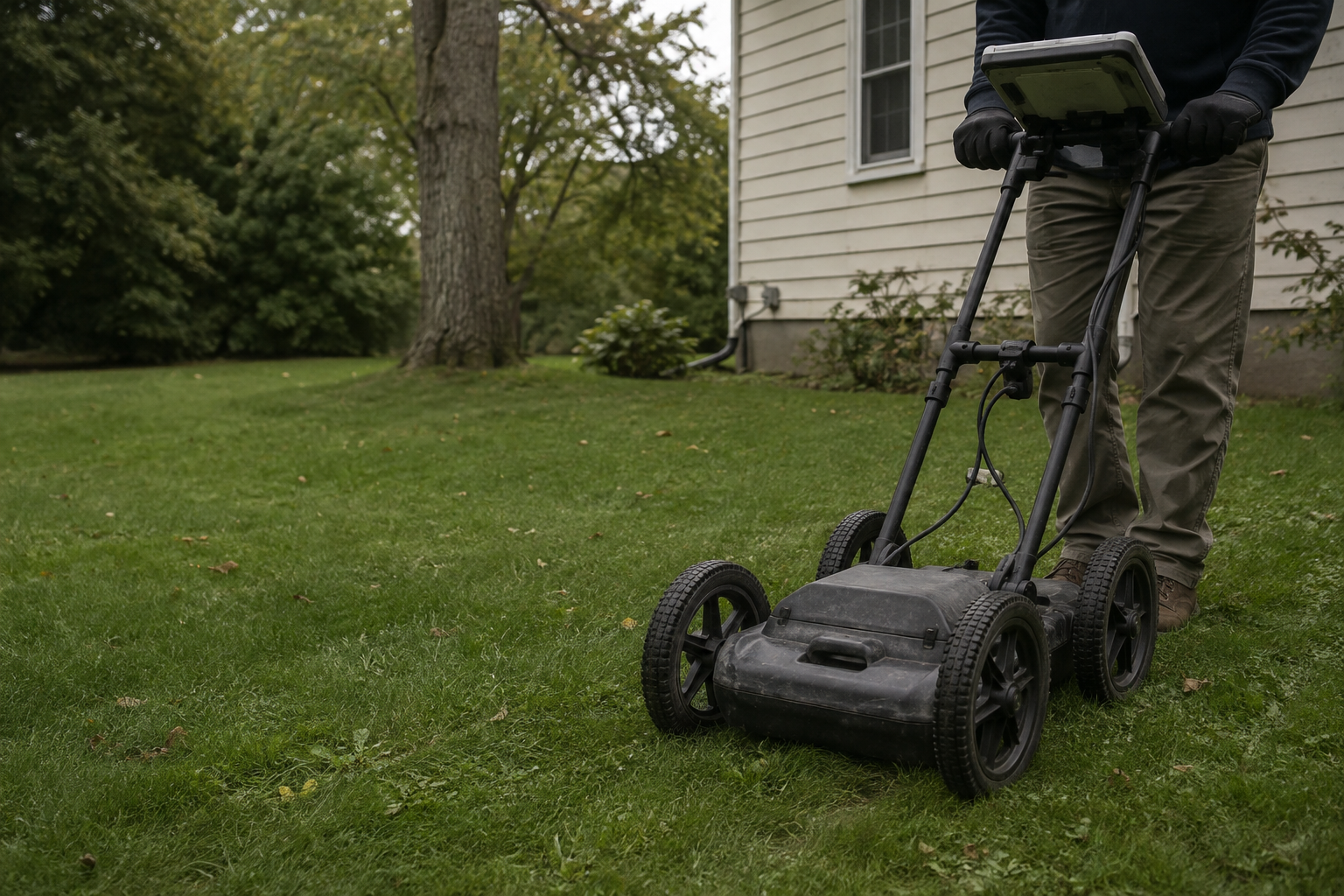
Detection, tank closure, and environmental remediation can overlap, but they are not the same assignment.
Ask how a sweep is scoped, which accessible areas are included, what can limit the tools, and what written report is provided.
Read the sweep guideTank location, contents, access, permit history, testing, restoration, and possible evidence of a discharge can all change the scope.
Review removal decisionsSeparate what was observed from what still needs evaluation. Ask which qualifications apply before anyone disturbs the area.
Compare scope and cost factorsYou do not need every answer. A few concrete details can make the first call much more useful.
A useful report describes the scope and limitations, not just a simple yes or no.
A provider may discuss visual clues, property records, metal detection, ground-scanning tools, or a combination of methods. Soil, utilities, hardscape, access, and other site conditions can affect what is practical.
Oil tank questions are tied to a specific parcel, not just a county name or a search phrase.
Two Essex County homes with a similar age can have very different heating histories. One may still use heating oil. Another may have converted fuels decades ago, with clear closure records. A third may have an exterior pipe, a patched foundation opening, or a vague disclosure that raises a question without answering it. That is why the useful starting point is the exact property and the evidence already available.
The municipality matters because permit and construction records are maintained locally. Ask the local construction office how to request records for the address and what date range is available. A provider may use those records as context, but records research and a physical sweep are not interchangeable. Each can answer a different part of the property-history question.
Access matters as much as history. Additions, patios, driveways, retaining walls, fences, slopes, utilities, parked vehicles, heavy landscaping, and locked spaces can affect what can be reviewed. Mention those conditions before scheduling. It is better to define a limitation early than to assume every part of the property will be accessible on arrival.
The most reassuring claim is not always the most useful one. Ask for details you can verify.
Begin with the provider's full business name and the work it proposes to perform. If underground tank closure, subsurface evaluation, or remediation may be involved, ask which New Jersey certification category applies and who will be responsible for that portion of the work. Verify important credentials through current official sources rather than relying only on an advertisement or logo.
Next, compare written scopes line by line. For a sweep, look for the accessible search area, methods, records component, limitations, report format, and response to an uncertain signal. For removal, look for permits, tank contents, excavation, disposal, testing, laboratory work, backfill, surface restoration, documentation, and the procedure if evidence of a discharge appears.
A professional answer can include uncertainty. Property conditions are not fully known from a telephone call. What matters is whether the provider explains that uncertainty, avoids a guarantee it cannot support, and gives you a way to understand changes before they become extra work.
The call should turn a messy history into a clearer next question.
Start with a short factual summary: the address, your role, the current heating fuel, the clue or document that raised the question, and the deadline that matters. If a report exists, read its exact conclusion rather than paraphrasing it from memory. If you noticed a pipe, patch, odor, stain, or sheen, describe where it is without pulling, opening, or excavating anything.
The call can then focus on fit. Is the request a sweep, a known-tank removal discussion, help understanding an earlier finding, or a possible discharge that needs a qualified evaluation? Does the provider cover the municipality? What information should be gathered before an appointment? Which part of the property needs access? What documentation can be expected?
Before the call ends, repeat the provider's business name and the proposed next step. Ask whether a written scope will follow and what would need to be confirmed before scheduling. Write down the date, the person you spoke with, and any documents the provider asked you to send or locate. Keep those notes with the property records. The website does not set the provider's price or terms. Those details should come directly from the provider and be reviewed before work is authorized.
Open the telephone contact checklist or prepare for an estimate discussion.
Check the source
NJDEP says underground unregulated heating-oil tank closure work requires an appropriately certified individual working for a certified firm. If a discharge is found, reporting and remediation duties can change the next steps.
Prepare, then call
Have the property address, your deadline, known heating history, and any prior report ready. You do not need to know the final scope before calling.